Throughout history, flowers have gone beyond their ornamental function and have become a symbolic language through which emotions, ideas and feelings can be expressed.
This code, known as the language of flowers, has its roots in ancient civilisations. Many of the meanings that we today associate with certain species come from Greek and Roman mythology, where flowers often emerged from metamorphoses involving gods, nymphs or heroes.
Later, in the 19th century, during the height of Romanticism and the Victorian era, this code reached its greatest popularity. In a society governed by strict social conventions, giving a bouquet could become a subtle way of declaring love, expressing friendship, asking for forgiveness or conveying feelings that could not be openly spoken. Floriography manuals, which were highly popular during this period, gathered the meanings attributed to each flower and allowed people to create authentic secret messages through floral arrangements.
To explore this symbolic universe, we have drawn on one of the key 19th-century reference manuals, Le Langage des fleurs, published under the pseudonym Charlotte De La Tour and attributed to the writer Louis-Aimé Martin. This work gathers the meanings associated with numerous floral species and helps us understand how, at that time, each flower could become a word within a silent language.
The Carmen Thyssen-Bornemisza Collection preserves several works in which flowers take on a special role. Through these examples, we can explore how different artists have incorporated floral symbolism into their compositions and discover how each species can conceal its own meaning.
A bouquet full of messages: Jean-Baptiste Monnoyer
A magnificent example is this bouquet by Jean-Baptiste Monnoyer, entitled Bouquet of Crown Anemones, York and Lancaster Roses, Jonquils, a Hyacinth, a Tulip and Bear’s Ears, tied with a blue ribbon. It may appear to be simply a splendid floral still life, but it actually contains a symbolic reading. Each flower contributes a meaning and, together, they create a story that 17th- and 18th-century viewers were accustomed to deciphering.
Anemones symbolise the fragility of beauty and abandonment. According to mythology, the nymph Anemone awakened the love of Zephyrus, god of the wind. Flora, goddess of flowers and Zephyrus’ wife, blinded by jealousy, transformed her into a flower. Since then, it has bloomed for a short period and its delicate petals easily fall with the wind. For this reason, it became a symbol of ephemeral beauty: something beautiful yet fleeting.
The hyacinth also comes from a classical myth. Apollo transformed the young Hyacinthus into a flower after his death during a game. For this reason, this flower is associated with remembrance and memory, but also with the playful origins of the legend.
Among the flowers in the bouquet we also find two York and Lancaster roses, a very special variety that combines white and pink tones within the same flower. Its name takes us back to the famous Wars of the Roses, the conflict between the Houses of York and Lancaster in 15th-century England, traditionally represented by a white rose and a red rose. In the language of flowers, this variety can evoke reconciliation and the union of opposites.
The message is completed by musk rose, associated with desire, and the tulip, which in European floral tradition became a declaration of love.
But Monnoyer is not the only artist in the Carmen Thyssen-Bornemisza Collection who speaks to us through flowers…
Flowers as symbols in other works from the Carmen Thyssen-Bornemisza Collection
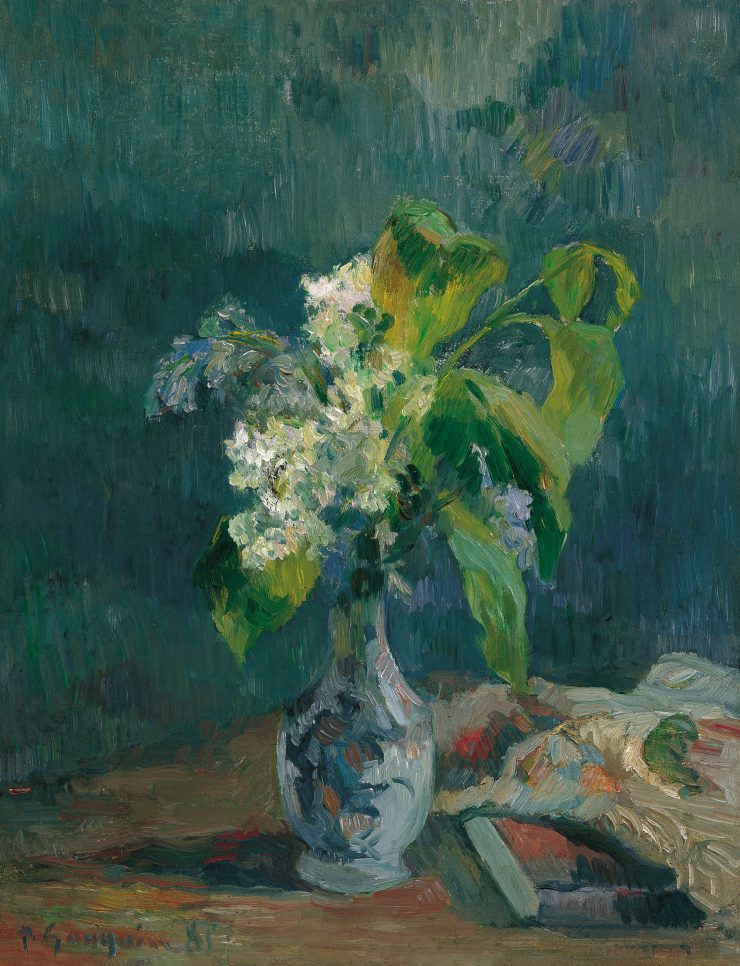
In Lilacs by Paul Gauguin, the delicate lilac bouquets evoke youth and renewal. Their brief flowering period and their connection with spring turned this flower into a symbol of the early years of life, freshness and the beauty of beginnings.
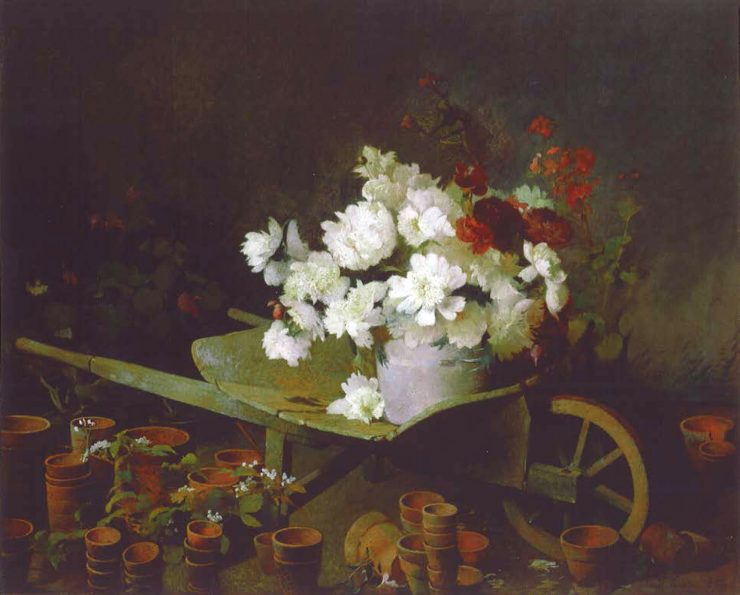
In Cart with Peonies by Emil Carlsen, the exuberant peonies reveal a flower with multiple interpretations. In many Asian cultures, they are symbols of prosperity, honour and good fortune, while in some 19th-century European floral language manuals they could be associated with shame or shyness. This diversity of meanings reminds us that floral symbolism often depends on cultural and historical context.
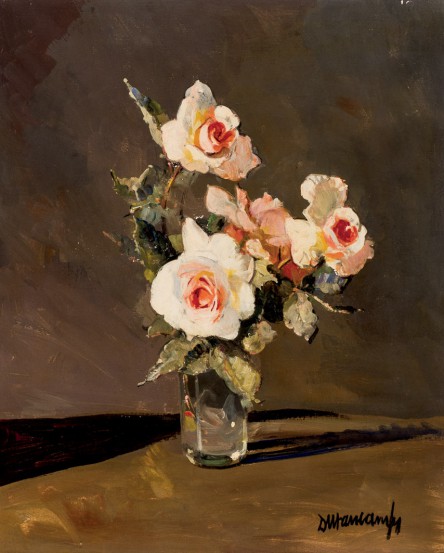
Roses also take centre stage in Flowers in a Vase by Durancamps. Few flowers have accumulated as many meanings throughout history as the rose. Traditionally associated with love and passion, its message could vary depending on the colour and arrangement of the bouquet. Its presence in this work reinforces the idea of beauty, affection and emotion.
Finally, in Patio of the Sorolla House by Joaquín Sorolla, flowers form part of the garden’s luminous and vibrant atmosphere. Although it is not always possible to identify every species represented with precision, the flowering vegetation contributes to conveying a sense of serenity, harmony and connection with nature, so characteristic of the gardens that inspired the artist.
Today, it is no longer common to communicate through bouquets of flowers, but this language continues to awaken our curiosity. Discovering the meaning of flowers allows us to look at works of art from a new perspective and understand that, often, behind a simple bouquet lies a story filled with myths, emotions and symbols.
The next time you observe a floral still life in a museum, take a moment to pause. Perhaps the flowers have something to tell you.