

If we had to eat only what’s in season, without greenhouses or imports from the other side of the world, would we know what’s on offer today? The honest answer is probably not. We’ve grown up surrounded by fridges stocked full all year round, with strawberries in December and oranges in July, and we’ve gradually lost that seasonal narrative that once shaped people’s lives, including at the table.
Curiously, there’s one place where this narrative remains intact: still-life painting. Far from being just “pretty still lifes,” Baroque still lifes are genuine gastronomic and agricultural documents. A 17th-century painter couldn’t simply invent a melon in January, because quite simply, none existed at any market stall. Today we’ll take a short journey through this painted calendar by way of one very specific example: the series The Four Seasons by Francisco Barrera (1638), held in the Carmen Thyssen-Bornemisza Collection.
The still life is a pictorial genre centred on everyday objects — food, kitchen utensils, flowers — that flourished in Spain and Flanders between the 16th and 17th centuries. Its strength as a historical source lies precisely in its meticulousness: the painter worked from life, using the produce he had physically in front of him, seeking extreme realism in the textures, ripeness and colour of each item.
And here lies the key point: before global transport and cold storage, eating seasonally wasn’t an “eco-friendly” choice or a trend; it was, quite simply, the only option available. That’s why, when a still life shows us artichokes, cherries and asparagus together, it isn’t artistic licence — it’s a faithful snapshot of that particular month’s market.
There’s also a fascinating phenomenon here: the gradual arrival of New World produce (tomato, pepper, bean, potato, corn), which was incorporated very slowly into Spanish still lifes, often mixed in with traditional produce of Mediterranean and Asian origin. A painting like Barrera’s captures precisely this moment of transition.
Francisco Barrera’s calendar (1595-1658)
In this series, each canvas is a seasonal allegory: a symbolic figure in the background signals which time of year we’re looking at, while in the foreground a table laden with produce shows us, in full detail, what was being grown, fished or hunted at that moment. It’s one of the most complete records we have of 17th-century diet.
Spring: Represented by Flora, goddess of flowers. On the table we find cherries, loquats, apples, lemons, asparagus, broad beans, artichokes, cheeses, among others. These elements reinforce the symbolism of spring.
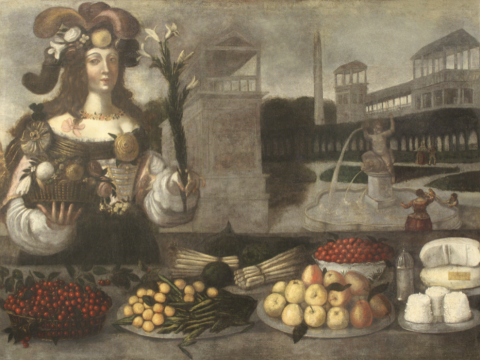
Barrera Francisco, Spring 1595-1658
Summer: A boy carrying a sheaf of wheat on his shoulders symbolises summer. Among the foods shown are melon, peaches, pears, plums, figs, wafers, sweets, honey… In the background, scenes of peasants harvesting wheat. Summer is, above all, the time of the grain harvest and abundant sweet fruit.
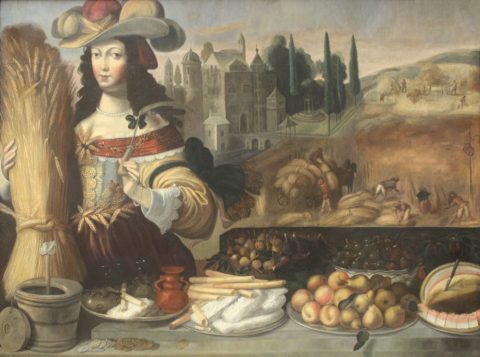
Barrera Francisco, Summer 1595-1658
Autumn: The composition revolves around the grape harvest: in the foreground, a young man picks grapes from a vine and loads them onto a donkey, while in the background a group harvests a vineyard. The table shows grapes, apples, pomegranates, pears… The whole scene centres on the harvest and autumn produce, reflecting the stone fruit, ripening and preserving characteristic of this time of year.
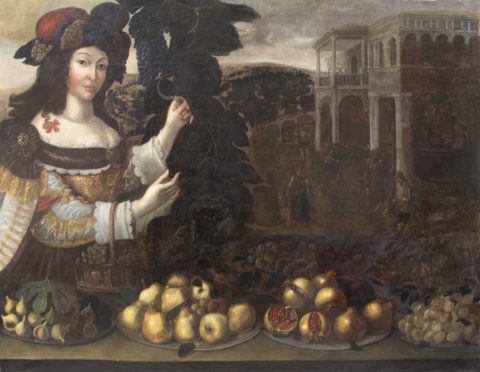
Barrera Francisco, Autumn 1595-1658
Winter: In the foreground we see a figure warming his hands by the embers, with a snowy landscape behind. Here, what we find on the table are cured meats, jars of jam, preserves, sweets… Unlike the other seasons, winter is above all a time for preserving — pig slaughter, nougat, jams — rather than fresh harvest.
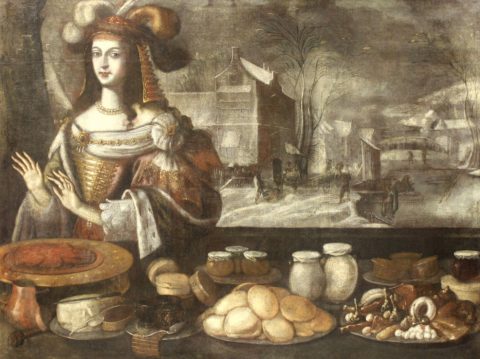
Barrera Francisco, Winter 1595-1658
Beyond telling us when each thing was eaten, still lifes let us see what each food physically looked like before genetic selection and intensive farming transformed it.
Comparing the artichokes, carrots or watermelons in these paintings with today’s versions, the changes are clear: smaller, more irregular specimens, less uniform colours, and shapes we’d now struggle to recognise. Carrots, for instance, weren’t always orange (there were purple and whitish varieties too); watermelons showed flesh that was far less red and compact, full of gaps inside; and many stone fruits, like peaches or plums, were depicted small, fuzzy and quite markedly ripe, far from the uniformity of today’s supermarkets.
These details are neither coincidence nor artistic licence: the painter painted exactly what was in front of him. That’s why food historians and botanists often use still-life paintings as a source for reconstructing the evolution of agricultural varieties, much as a naturalist would use a herbarium.
Setting this “painted calendar” side by side with our own fridge invites a simple but uncomfortable reflection. We’ve gained access to almost any product almost any day of the year, but we’ve probably lost the distinct flavour of each season, the natural rhythm that once shaped cooking, and the direct connection to the land.
Next time you wander through the market or open the fridge, it might be worth asking the question the other way round: of these products, which ones could Francisco Barrera have painted this very month?