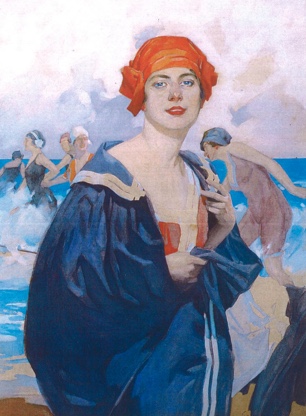


Few subjects have run through the history of Western art with as much continuity as the depiction of the female body while bathing. From fourth-century BC Greek sculpture to the twentieth-century avant-gardes, the bather motif has allowed artists to explore anatomy, light, landscape, and the relationship between humankind and nature all at once. So let’s trace the origin of this iconography, the deeper reasons for its persistence, and, above all, how each period’s society responded to it: with ease, with scandal, or with a moralism that often concealed as much interest as censorship.
It all begins in classical Greece, with Praxiteles’s “Aphrodite of Knidos” (fourth century BC): the first great sculpture of a nude female body, caught in the very act of bathing. Legend has it that the city that commissioned it rejected it as too daring, and that neighbouring Knidos took it in and turned it into a first-class tourist attraction. The first “scandal plus profit” story in the history of art, some 2,400 years ago — it turns out that marketing built on controversy is no modern invention.
On the whole, though, the Greek and Roman nude enjoyed good press: ideal beauty, a matter for goddesses, and public baths that were simply normal. The odd controversy here and there, sure, but nothing compared with what was to come.
Then Christianity arrives, and the nude loses all its privileges. From now on, a naked body can only be shown if there is a sufficiently compelling moral justification for it. The star case: “Susanna and the Elders”, in which two old men spy on her as she bathes in the garden. The painting “condemns” lasciviousness… while placing the viewer in exactly the same position as the leering old men. Moralising and looking at once: double the pleasure (and, it must be said, one of art history’s earliest examples of “it’s not what it looks like”).
With the Renaissance, artists revive the old Greek alibi: if the bather is a goddess, anything goes. Venus, Diana, nymphs of the sacred grove… mythology becomes the VIP pass for painting nude bodies without complications. In private, things flow freely; in public, the odd touch-up or bit of censorship still crops up from time to time.
A late and telling example of this tradition is “The Bath of Diana (The Fountain)” by Jean-Baptiste-Camille Corot (c. 1869–1870), held in the Carmen Thyssen-Bornemisza Collection. Corot depicts the goddess Diana in a wooded setting, still following the mythological logic that legitimises nudity. It is telling that, four centuries after the Renaissance, Western painting still relied on the very same justifying device: the bathing goddess as a narrative frame that makes socially acceptable what, without it, would have been problematic. An excuse with remarkable staying power, it must be said.
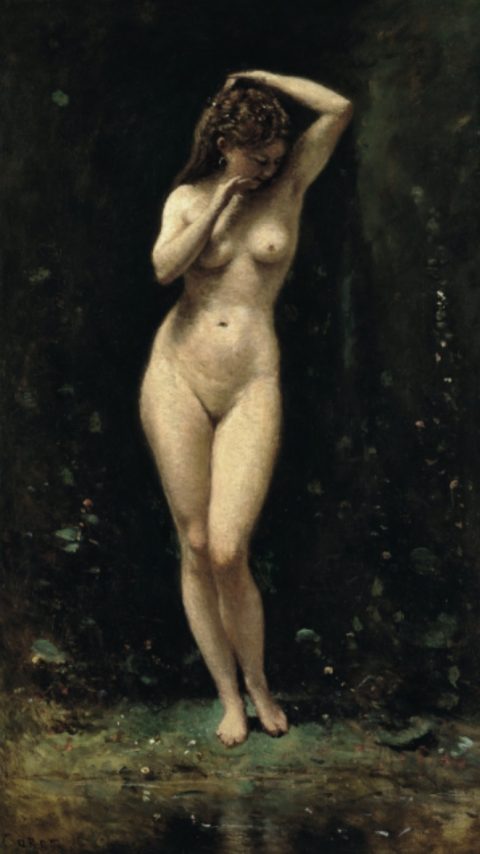
Corot, Jean-Baptiste-Camille, El Baño de Diana, 1869-1870
The nineteenth century marks a decisive turning point. On the one hand, academic painters continue producing mythological bathers — nymphs, goddesses, allegories — intended for the official salons, where their reception is generally favourable so long as they conform to the canons of idealised beauty set by the Academy.
At the same time, another, more genre-based and socially less controversial current develops, portraying bathing as a form of bourgeois leisure: beaches, public baths, family scenes by the sea. “Bathing on the Beach by the Carts,” a watercolour by José Navarro Llorens (c. 1915), is a good example: a woman is shown drying a girl who has just been bathed in a basin, while oxen drag a fishing boat.
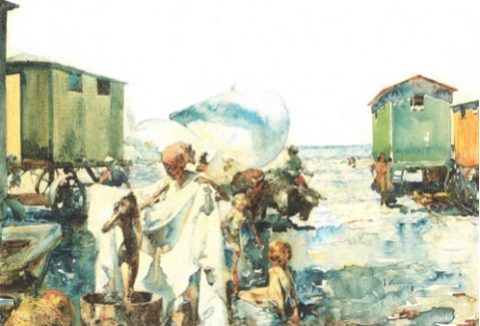
Navarro Llorens Jose, Baño en la playa junto a los carromatos, 1915
The reception of works such as “The Bath (Seville)” by Francisco Iturrino (c. 1908) is more complex, part of a series produced during his stay in Andalusia. Iturrino’s work belongs to a broader search for Mediterranean authenticity that runs parallel to Gauguin’s flight to Polynesia: bathing here becomes a symbol of a “primitive” vitality and light, far removed from European industrialisation. This form of Mediterranean orientalism enjoyed a favourable critical reception in avant-garde circles, though it was not free of the exoticising gaze typical of the colonial period, an aspect more recent historiography has begun to question.
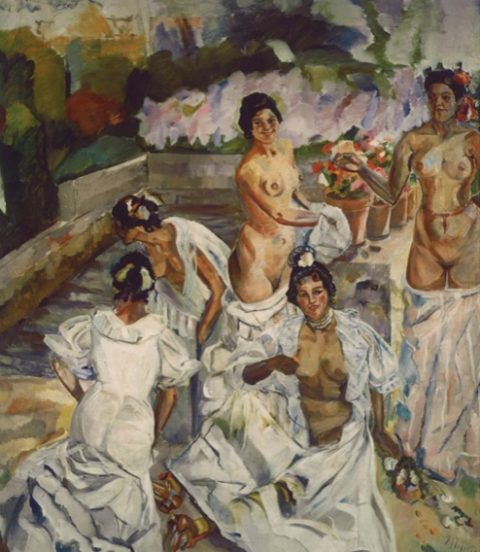
Iturrino Gonzáles Francisco, El baño, 1908
Straddling the nineteenth and twentieth centuries, the Symbolist movement forcefully revives the mythological iconography of bathing, but with a very different sensibility from the classical one: the aim is no longer to depict ideal beauty, but to evoke dreamlike, mysterious atmospheres. “The Bathing of the Nymphs” by Antonio Muñoz Degrain (c. 1915, originally titled “The Night Bath”) is one example: a group of nude women bathe at night in a river, beneath a moon that tints the landscape in unreal hues. Here Muñoz Degrain revives the myth of the bathing nymphs at a moment when European Symbolism was seeking exactly this kind of imagery: suggestive, ritualistic, distanced from explicit mythological narrative and therefore less bound by the moralising reading that had shaped the genre for centuries. The reception of such works in Symbolist and Modernist circles was generally positive, since they belonged to an aesthetic of escape highly prized by contemporary critics.
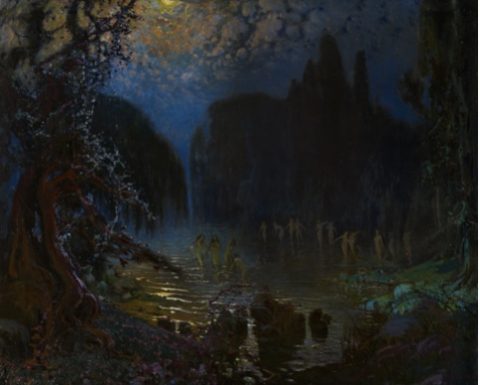
Muñoz Degrain Antonio, El baño de las ninfas, 1915
The twentieth century radically transforms the meaning of the motif. With Cézanne as a transitional figure — his successive series of “Grandes Baigneuses” abandon all narrative pretence to turn the body into a purely compositional problem — bathers become, for many avant-gardes, a formal pretext: a way of working out the relationship between figure and space, between volume and colour, with no need for mythological or anecdotal justification.
By the 1920s, the motif had become firmly established as an autonomous genre within modern painting, explored from a wide range of perspectives: from those still seeking a certain classical idealisation of the body to those who, following the avant-garde’s lead, treated it as a mere geometric and chromatic pretext. Works generically titled “Bathers” (c. 1920–1924) and “Public Baths” (1815), also held in the Carmen Thyssen-Bornemisza Collection, testify to this multiplication and normalisation of the theme during the interwar period, when depicting the bathing body had, in most cases, ceased to require any special justification to be socially acceptable within the artistic sphere.
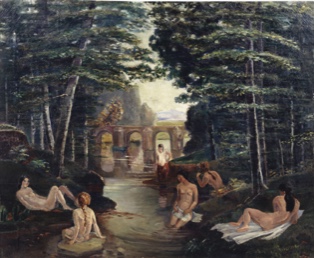
Benet i Vancells Rafael, Bañistas, c.1920-1924
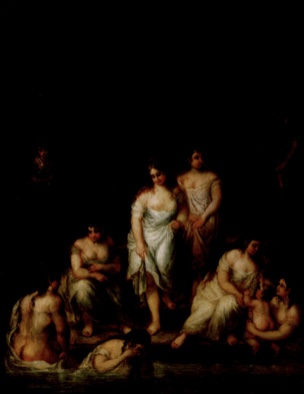
Romero y López José María, Baños públicos, 1815
Ultimately, the history of the bather motif is not so much the history of a stable iconographic subject as that of a cultural mechanism in constant redefinition: a way of negotiating, in every period, just how far and under what conditions society was willing to accept the depiction of the naked female body.