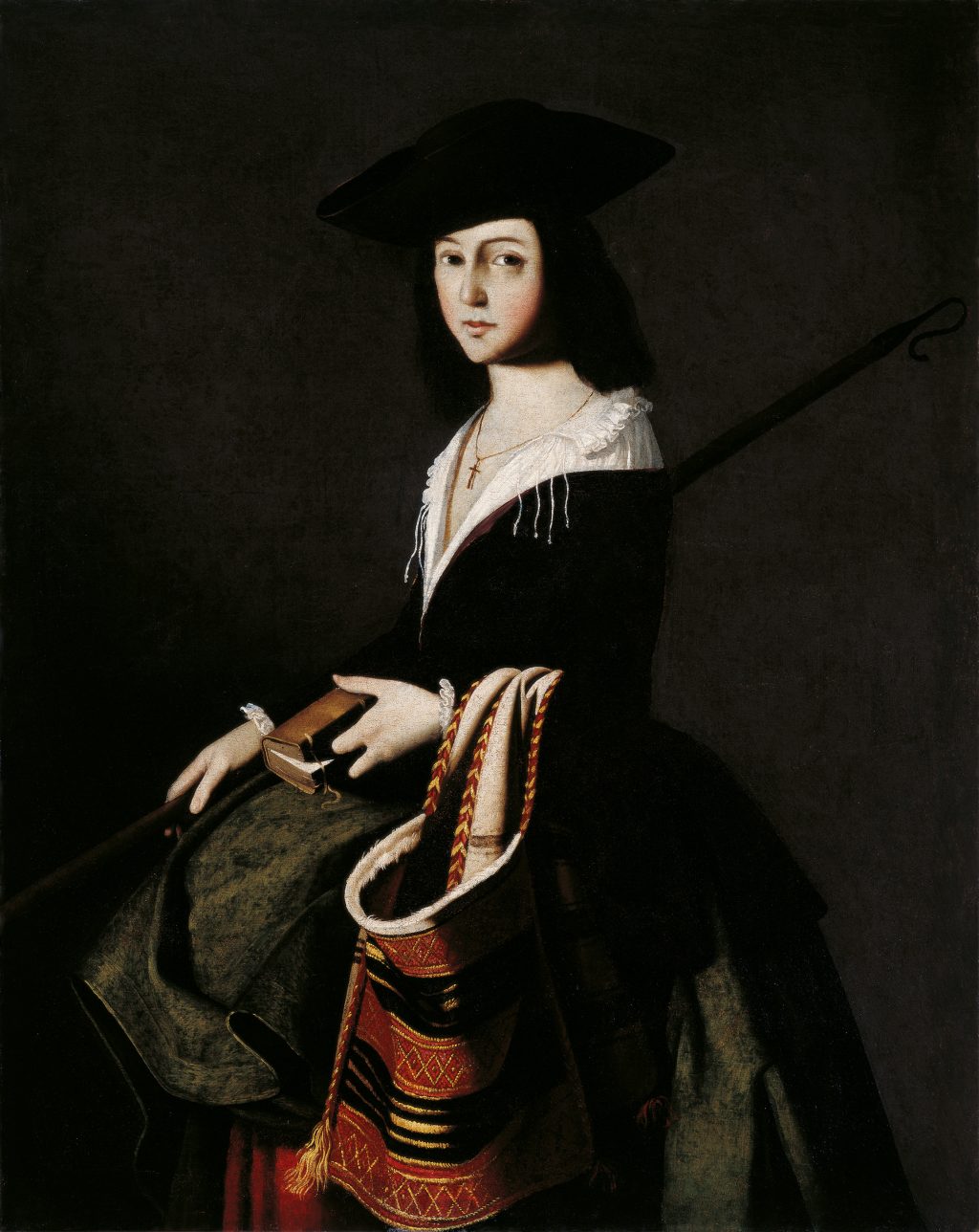

When we look at Saint Marina by Francisco de Zurbarán, we may feel that we are looking at the depiction of a saint with a clearly defined identity. Yet her story is far more complex than it first appears. Over the centuries, different traditions and legends became intertwined, leading to the confusion of several saints who shared the name Marina and giving rise to an iconography that is both rich and remarkably complex.
The Legend of Saint Marina
In the Hispanic tradition, Saint Marina is identified as a virgin and martyr of the early centuries of Christianity, especially venerated at Augas Santas, near Ourense, of which she is the patron saint.
According to tradition, after her martyrdom and beheading, three springs miraculously emerged where her head fell, turning the site into an important place of pilgrimage. This episode explains some of her most characteristic iconographic attributes: the springs, the oven in which she is believed to have suffered martyrdom, and the palm branch, symbolizing the victory of the martyrs.
However, the lack of historical sources concerning her life encouraged her story to become intertwined with those of other saints who also bore the name Marina.
Marina of Antioch and the Medieval Confusion
During the Middle Ages, popular devotion frequently merged the Galician saint with Marina of Antioch, who was often identified with Saint Margaret of Antioch, famous for the legend of the dragon that attempts to devour her before her martyrdom.
At the same time, Jacobus de Voragine’s Golden Legend popularized the story of a very different Marina: a young woman who, disguised as a man under the name Brother Marinus, entered a monastery together with her father. Years later, she was falsely accused of having impregnated a young woman. Marina accepted her punishment without ever revealing that she was a woman, enduring humiliation and expulsion from the monastery until, after her death, the monks discovered the truth and recognized her extraordinary humility.
These three traditions coexisted for centuries, explaining why many representations of Saint Marina combine attributes drawn from different narratives, such as the dragon inherited from the confusion with Saint Margaret of Antioch.
Zurbarán: A New Way of Depicting the Saint
Rather than following an established iconographic tradition, Zurbarán removes almost all of the saint’s conventional attributes. His Saint Marina is not surrounded by flames, nor accompanied by a dragon or miraculous springs. Instead, she stands alone, illuminated by a powerful beam of light against a dark background that focuses all attention on her presence.
She is dressed like a seventeenth-century woman: a white blouse, a black bodice, a red skirt, a green mantle and a wide-brimmed country hat. In her hands she holds a prayer book and a long shepherd’s staff ending in a hook. A small cross on her chest is almost the only unmistakably religious element.
This treatment reflects one of Zurbarán’s most distinctive artistic qualities. His female saints are not supernatural visions but approachable human figures. For many years, scholars interpreted them as genuine portraits à la divine—that is, portraits of contemporary women represented under the patronage of the saint whose name they bore. Although this theory does not explain every case, it helps us understand why these paintings convey such a striking sense of realism and everyday presence.